


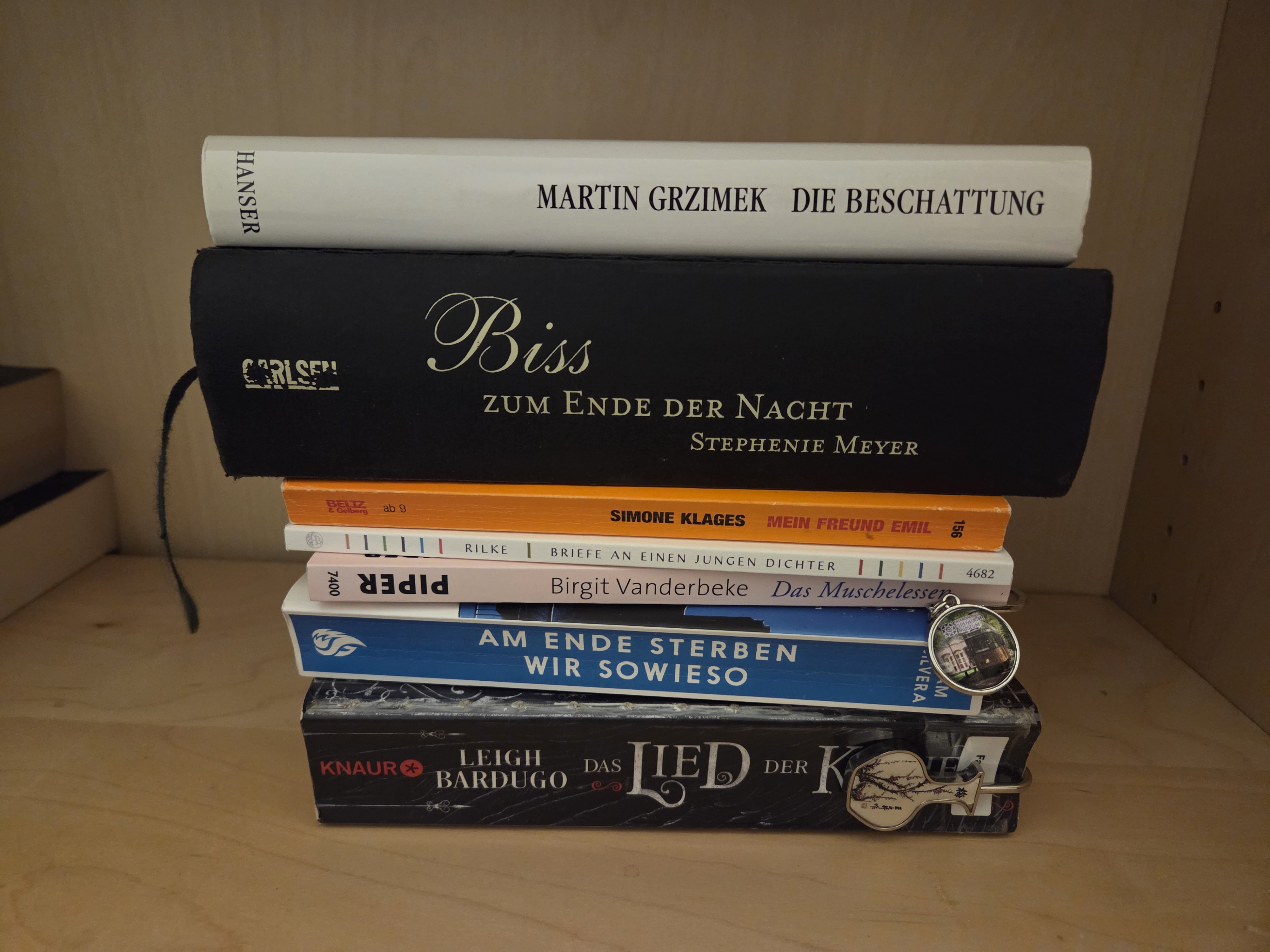
I am studying abroad in Germany as a participant in a total language immersion program. While my German language skills improved both rapidly and vastly at the beginning of my program, I noticed that my progress started to plateau once I had reached a certain advanced level. This is not uncommon when learning languages and it is not to say that I stopped improving, but the improvements became smaller and less immediately noticeable. This plateau led to some frustration and meant that I had to be more intentional with some of my language learning strategies. Still, I continued to build and expand my German skills and currently possess a C1 language level.
Here are some things I did both before and after experiencing the plateau in order to maximize and take advantage of language immersion:
Read!
Likely the single most helpful strategy I utilized for improving all-around language skills was simply reading, and reading every day. The slightly tricky part for me was finding German books or short stories which both captured my interest (I found that if I didn’t actually want to read, then I wouldn’t do it every day) and wasn’t so difficult that I would get frustrated and then quit. I started with a children’s book but then quickly moved on to young adult novels and even more advanced ones. In my experience, once I had established the habit of reading frequently and had finished the first couple of books, I was able to quickly advance the difficulty level. Though I read increasingly more advanced books, the act of reading in German simultaneously became faster and easier.
Aside from improving, well, reading comprehension, reading regularly also expanded my understanding of grammatical structures in addition to increasing my vocabulary by exposing me to many idiomatic expressions and less common words . This, in turn, increased my auditory comprehension as I started to recognize these structures and words in conversation. If I could only give one recommendation to others attempting to learn a language, it would be to read in that language as often as you can!


Talk.
This one is pretty self-explanatory, but it is also by far what I did most frequently as well as the most efficient way to improve language skills. I live as one of 27 students together in one house, and I established at the very beginning a hard rule for myself to only speak to my housemates in German. Prior to my time studying abroad, I had only ever utilized German in academic settings, but I have now been exposed to it in casual and social environments, too. Whether ordering in restaurants, asking for directions, bargaining at flea markets, or collaborating with my fellow interns, I use German in as many contexts as I can. Purely putting my language skills into active practice has dramatically improved my speech skills and interactions with native speakers have also taught me new expressions and vocabulary.
However, it is not uncommon that someone new recognizes my accent and attempts to switch the conversation to English, even though I had initiated in German. Over time, I learned to stand my ground and to continue to respond in German or express my preference to practice.
Listen to music.
Though I already spoke advanced German at the time, when I first arrived in Germany, I couldn’t understand very much German music at all. The words are often fast or abbreviated, and it would go in one ear and out the other. However, I took recommendations from housemates and friends and started building German playlists which I would listen to in my free time, when doing homework, riding the bus, or in the kitchen while cooking meals. Reading through the lyrics while listening helped me recognize words and understand what was being sung about. Then, the next time I listened to the song, I would be able to pick out the words without looking at the text. Aside from that, having German music as background noise also simply helped acquaint me with hearing the language frequently. Subconsciously, I began to understand and recognize words quicker and more naturally.


Watch movies and shows.
Exposure to German media has also helped me not only with my language skills, but also in understanding German humor, history, and culture.
Play the game.
A fellow language learner shared a “game” with me that he will play while taking walks, which I have since adopted. I will notice whatever I see around me and in my head say in German “there is a bike (da ist ein Fahrrad)” or “there is a pharmacy (da ist eine Apotheke),” and so forth. Sometimes, I would also narrate in my head in full sentences what I was seeing. This little game was helpful for me to start thinking a bit in German.
Switch your phone into the language.
Towards the beginning of my time in Germany, I realized that I could change the language of my Google account. Now, every time I open the internet or any related apps, it is all displayed in German. This is, of course, easily reversible but at the moment forces me to process and practice German whenever I interact with certain services on my phone.

One last tip:
If I were to give a couple of recommendations to others interested in a full immersion experience they would be: don’t stay exclusively in a bubble. My particular exchange program is specifically for Americans studying abroad in Germany, meaning I am very often in the company of other Americans, with whom I speak English. The people in my program offered an immediate group of individuals who were experiencing the same things as I was in a new country, which meant we became close immediately. I continue to be good friends with them and still actively see and make plans with them a few times a week. There is absolutely nothing wrong with bonding with the people in one’s program. However, I would also strongly encourage making friends outside of the program, too. Interact with locals, classmates, and housemates. Join clubs or sports teams. Bond within your bubble but also remember to step out of it from time to time.
