


As the semester draws to a close, I wanted to use this post as an opportunity to reflect on my experiences as a research fellow this semester. Overall, I would say I’ve learned a lot about conducting independent research and the research process in general through this fellowship.
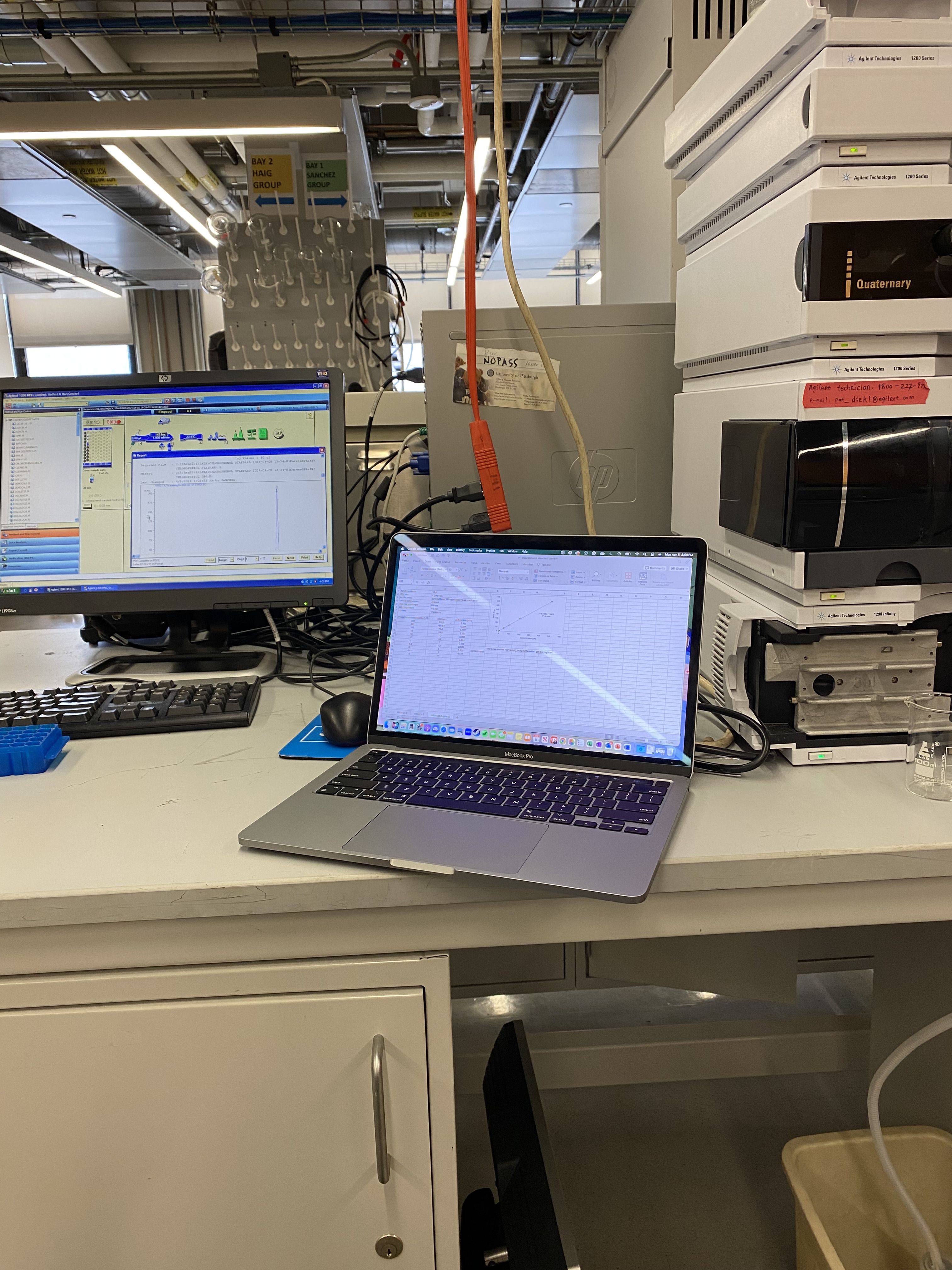
For anyone who needs a refresher on my project, here’s a quick summary of what I set out to do this semester. The lab I’m apart of has developed a novel compound (a kind of “nanozyme”) that we believed could be used to degrade bisphenol A. Our justification was that, since this particular nanozyme may mimic laccase, a class of natural enzymes, it should be able to degrade the same contaminants. My first goal was to measure the degradation of BPA carried out by this compound through analysis utilizing High Performance Liquid Chromatography (HPLC), which separates components of a sample and can allow for detection at low concentrations. My second goal was to characterize the products of this reaction using methods such as Mass Spectrometry and Infrared Spectroscopy, both of which can give details about the structures of chemical compounds. We also wanted to look at how different environmental conditions (temperatures, acidity, etc.) may affect degradation rates and extents.
When I wrote my proposal last semester, I was optimistic that I would be able to finish most if not all of the project I’d written about. With about three weeks of the semester left, though, I’ve only managed to complete some of what I proposed due to reasons I couldn’t have predicted a few months ago. The biggest obstacle that occurred was learning, after weeks of testing, that the compound we thought would degrade BPA, didn’t. After daily sampling spanning an entire week, the initial concentration of BPA was still present. This result was very disheartening, especially after the time I’d spent taking and analyzing samples, and all the weeks before I had spent getting the instrument to be fully operational. Still, with a little over a month left in my project, I couldn’t dwell on the outcome of these experiments; I had to move on to something else.
My supervisor suggested that I instead test the nanozyme’s ability to degrade chlorophenols, another water contaminant associated with many negative health effects, including cancer. We knew that the nanozyme made in our lab would be able to degrade chlorophenols based on new results from another member of the lab. I quickly developed new protocols for degradation testing and the first set of data looks promising! I’m very excited about the results so far and hope to make more progress on measuring the degradation rate and extent before the semester ends.
Something common across all research experiences I’ve had, including this fellowship, is that it never goes exactly as planned. This was especially true for this project, where I had a completely new focus by the end of the semester! It can be very difficult, especially in your first experiences with research, to not take “failed” experiments or ideas personally. Even though we weren’t able to observe any degradation of BPA by the nanozyme, we now know it has certain limitations compared to natural laccase enzymes. This is something new learned throughout the course of this project, and that is not something I view as a failure. Working to reframe your thoughts in this way is definitely my biggest advice to all—and especially new—researchers. Having experiments or projects go wrong is expected in research, but reframing how you view these experiences can help you from feeling discouraged.
Now that the CURF is over, I hope that this project can continue! I will be working in a fellowship at a different lab this summer, but my PI has plans to continue my project into the summer with a new undergraduate student. I’m confident that they’ll be able to make progress on the goals I had for myself this semester. Besides the project itself, I plan to remain actively involved in research on campus after this semester and begin applying to chemistry Ph.D. programs in the fall! The work I’ve been able to do because of the Chancellor’s Undergraduate Research Fellowship has been vital for both the research project I contributed to and my growth as a researcher. I’m very grateful towards the Frederick Honors College for providing me with this opportunity.

